CH 00 · Why It's Agent's Lego Era
Chapter Goal
Before writing this chapter, I kept going back and forth on whether it was worth the time to really understand dsh. The Agent framework market is crowded — one more or less feels irrelevant. But once I actually got hands-on, I realized dsh isn't in the same category as the others. It's not "yet another out-of-the-box Agent tool." It's a kit for assembling your own Agent.
This chapter doesn't teach you to type commands. It builds three intuitions. Once these three things click, every later chapter will make sense:
- What an Agent actually is — the official one-liner formula:
Agent = Model + Harness - Why we say "everything is a plugin" — that's what "Lego" means here
- Why now, specifically — what happened after the August 13, 2026 open source
Hands-on
Step 1: Write Down the Formula
DeepSeek officially describes dsh's positioning in a single sentence:
Agent = Model + HarnessModel is the LLM itself (the DeepSeek-V4 family, or any third-party model). It only handles "thinking." Harness is everything except the model: tools, prompts, memory, context management, task planning, multi-Agent collaboration, MCP, Skill… the shell that lets a model actually get things done.
A metaphor: the model is a fine horse; the harness is the bridle and tack. A horse without tack, no matter how fast, just spins in place. With tack, you can point it anywhere.
One line: the model thinks; the harness does.
Step Two: Understand "Lego"
The very first sentence of dsh's official README is:
It uses an architecture where everything is a plugin
Everything is a plugin. In plain words: the model adapter, tool registry, session log, Agent loop, UI, memory, scheduler — every one of these is an independent plugin block. You can pick, swap, delete, or add them in config without touching a single line of framework source.
Under the hood it runs on a TypeScript plugin system called Cordis (the team says it has been polished for four years). Behind a single dsh command sits a "plugin tree" built from more than 90 plugins. The diagram below shows its structure:
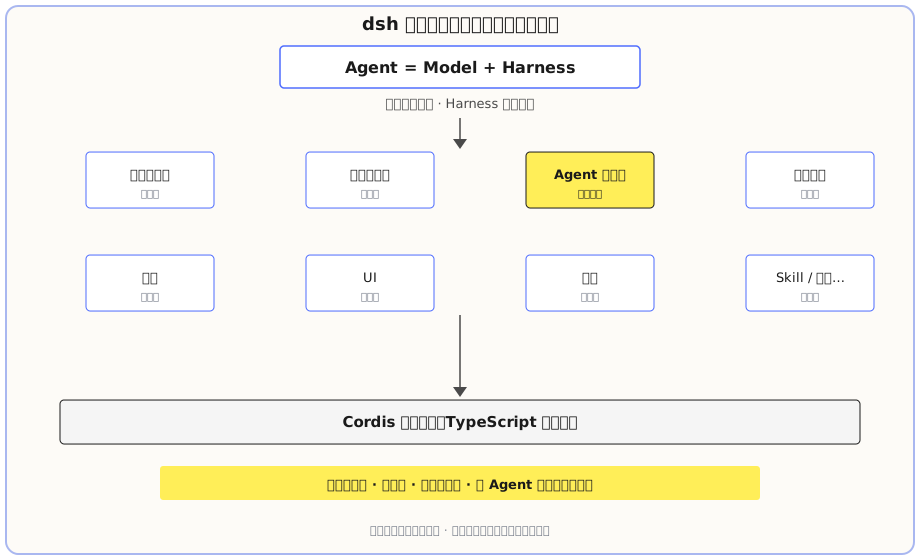
Two things to focus on in this diagram:
- The base is Cordis — every plugin lives on top of it, and Cordis manages them all uniformly;
- Even the Agent main loop is a plugin — that's the highlighted block in the middle. This is the most disruptive part: dsh has no core, no privileged path. Want to replace the default "think-execute" loop? That's not a massive framework rewrite — just swap a plugin.
That's "Lego": the base is fixed, but you can build any shape. Want a different model? Swap a plugin. Want a new tool? Install a plugin. Want a different UI? Install a skin plugin. Hence "Agent's Lego Era."
Step Three: See "Why Now"
On the evening of August 13, 2026, a new repository quietly appeared under the deepseek-ai organization. The description was a single line — "Everything is a Plugin." No launch event, no long-form announcement; the README even outright warned that "there will be breaking changes in the future."
Then the numbers went off the charts (all from media reports at the time, not official claims):
- 24 hours after open source: stars broke 46,000 (Hacker News hit #1)
- 48 hours after open source: stars broke 100,000
- 3 days in: stars exceeded 130,000, Forks near 14,000
- Plugin ecosystem: on launch night 288 plugin repos were indexed → within days, repos tagged
dsh-pluginexceeded 1,000 → 5 days in, over 6,000
Why the explosion? Because before this, an Agent's "body capabilities" — file access, terminal execution, tool calls, context organization — had been welded shut inside closed-source products like Claude Code and OpenAI Codex. Want to customize? Either use the vendor's plugin mechanism (limited by it), or build from scratch. This time DeepSeek open-sourced the entire layer — and broke it into Lego bricks.
Official Repository Card
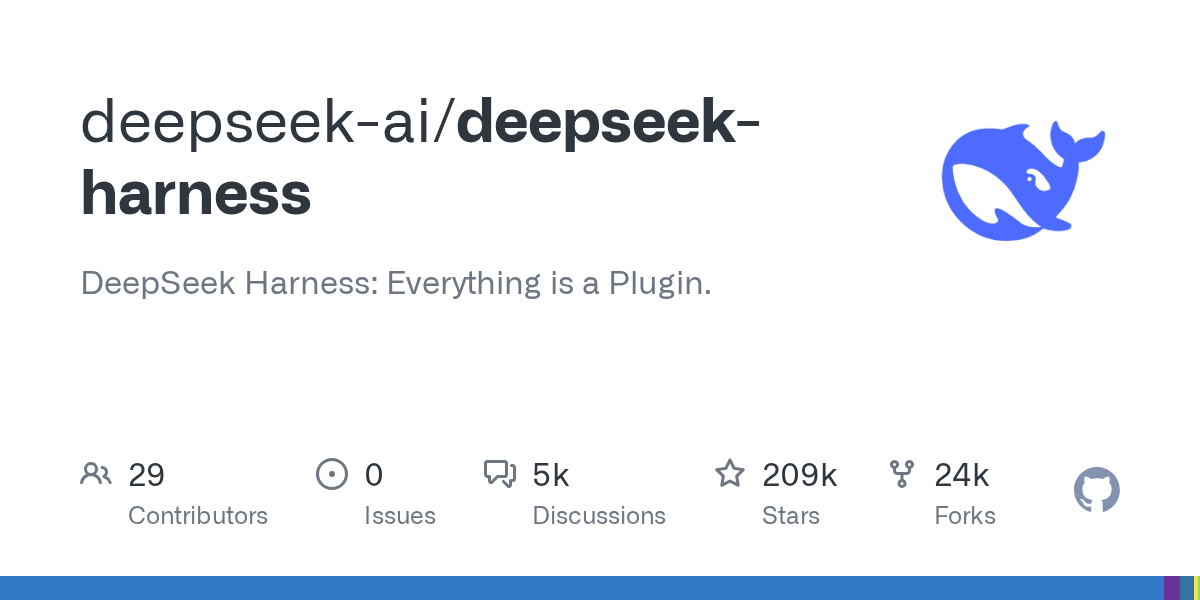
This is the repo card GitHub auto-generates for deepseek-harness: the tagline is exactly that line "Everything is a Plugin.", and on the right you can see the current star count (around 209,000 at the time of screenshot).
What you learned in this chapter
You pass if you can complete the following three items:
- [ ] Explain
Agent = Model + Harnessin your own words, and say what Model and Harness each handle - [ ] Name at least three "pluggable" components (e.g. model, tools, UI, memory, scheduler) and know that even the Agent main loop can be swapped
- [ ] State when dsh was open-sourced (2026-08-13) and what the repo's tagline is (Everything is a Plugin.)